Blog / Innovation
No one prospers alone
In an age of hyper-individualism, a lesson I brought back from China.

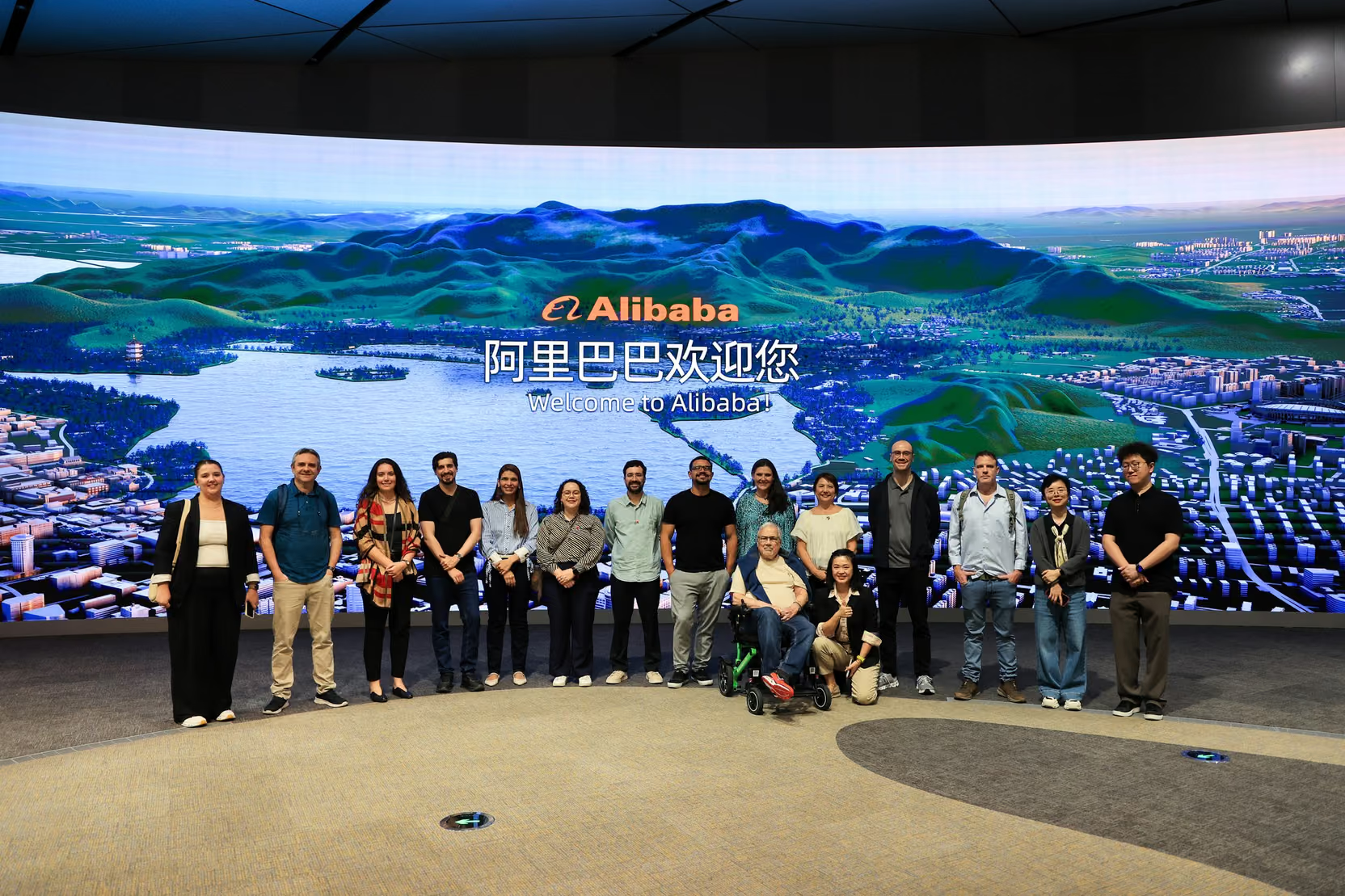
In October, I spent two weeks in China, split between Shanghai, Hangzhou, and Shenzhen, on the China Mission run by Cubo Itaú, Itaú’s innovation hub in São Paulo. The goal was to get to know the country’s business and innovation ecosystem better, in both theory and practice: we visited eight companies and attended two lectures at Shanghai Business School, one on China’s innovation ecosystem and the other on the country’s business culture.
One of the things that surprised me most on this trip was seeing that China, which is already the world’s factory and accounts for about 28% of global manufacturing value added,1 is also becoming a hub of technological innovation. In 2025, it entered the top 10 of the Global Innovation Index for the first time,2 and the Shenzhen–Hong Kong–Guangzhou cluster took first place in WIPO’s ranking of the world’s innovation clusters.3
Most people who make this kind of trip are trying to understand exactly how China pulled this off, to find inspiration, and maybe even to replicate part of that model in their own businesses. And after all these visits and so many rich conversations, you start to see a pattern that repeats across every one of these companies: lots of highly qualified people, vertical integration in manufacturing, lots of automation, artificial intelligence applied to everything, and a frightening speed of execution. It’s as if each company combined the precision of a Swiss watch with the power of a bullet train: everything moves very fast and goes according to plan.

Which brings me to the hard question: how did these companies manage to attract so much talent, build such automated and integrated manufacturing processes, and apply artificial intelligence so quickly and efficiently to real problems, both their own and their customers’? I’ll admit I came back to Brazil thinking a lot about this. I’ll say up front that I haven’t found the answer yet. The only certainty I brought back is that none of these companies got where they are on their own.
Gold, wood, and earth
One of the explanations that stuck with me most came from a professor at Shanghai Business School. He turned to the five elements of Chinese philosophy, 五行 (wǔxíng), a millennia-old idea that describes how things are born, grow, and transform, and picked three of them to show what holds up the Chinese model: gold (金, usually rendered as “metal” in English, though the same character means gold and money), wood, and earth.4
Gold is patient capital: money that is willing to wait. One example is the national fund the government launched, which is prepared to wait 20 years specifically to foster the creation and survival of deep tech companies.5 It’s a very different logic from that of traditional venture capital funds, which have much shorter lives: seven to ten years.4 That timeline is short for technology- and research-intensive companies, like those making chips, robots, or new materials, which take many years to bring in their first revenue. It’s in that gap, between the lab and the market, that many of them die, in the so-called “valley of death.” Patient capital exists precisely to help them cross it.
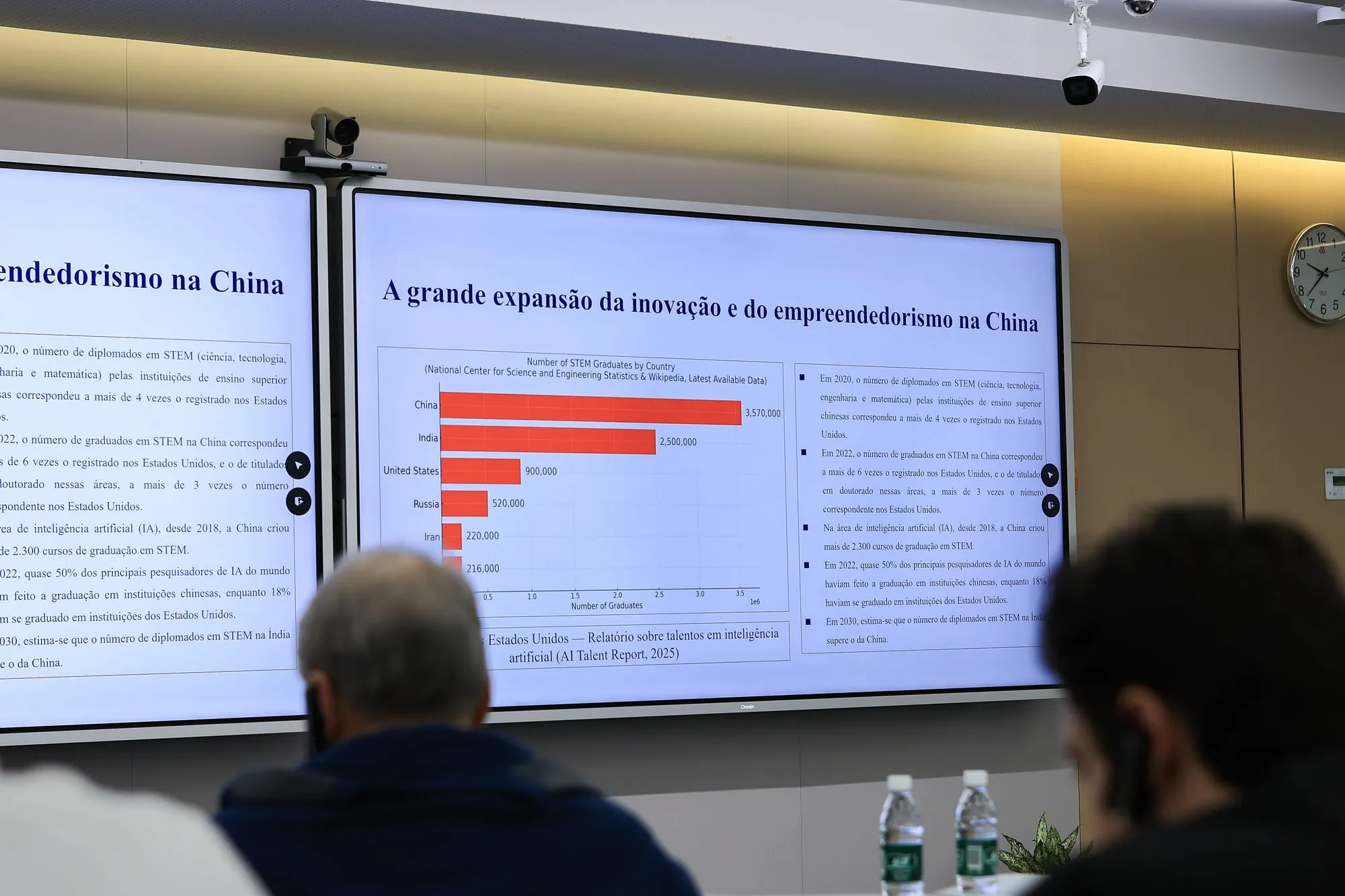
Wood is talent. The Chinese have a proverb that says it takes ten years to grow a tree and a hundred to raise a person.6 And China planted early: in 2020, it was already producing about 3.6 million STEM graduates a year, more than four times as many as the United States.7 It’s a forest of engineers that universities have been cultivating for years and that is now available in abundance to Chinese companies.
And earth is the government, which sees itself as a gardener: “I take care of the sunshine and the rain; you take care of growing.” There’s even a Chinese expression for this. The government should act like the 店小二 (diàn xiǎo’èr), the attendant at an old-style inn, who stays out of the way when there’s nothing to do and shows up quickly whenever he’s called.4,8 In practice, that means light, fast, flexible rules that protect new sectors without smothering them.
But earth is also what gives direction. The Chinese government has the ability to think long term and to guide everyone toward it. The country has been drawing up five-year plans since 1953 and is now on its 15th, which runs from 2026 to 2030.9 These plans are stepping stones toward even longer-term goals, for 2035 and 2049. And they don’t stay on paper: they cascade into ministry, provincial, and city plans and guide banks and companies. There’s a Chinese phrase for this too: 全国一盘棋 (quánguó yī pán qí), something like “the whole country is a single chessboard.” The targets also tend to be taken seriously. Made in China 2025, the industrial plan launched in 2015, had already met more than 86% of its 260-plus targets by 2024, according to a tally by the South China Morning Post.10
- 1st Five-Year Plan
- Shenzhen Special Economic Zone
- Made in China 2025 launched
- 86% of the plan’s targets met
- 15th Five-Year Plan
- Medium-term goals
- Long-term goals
At heart, the three elements only work together, as in Chinese philosophy itself, where each element feeds the next in a cycle. Without patient capital, talent doesn’t become a company. Without talent, money has no one to bet on. And without a government that prepares the soil and points the way, the other two end up scattered. We’re talking about a country that works as an integrated whole, takes the long view, and doesn’t chase good short-term results when they compromise future prosperity. Everyone has a meaningful role in building a prosperous China: the government, universities, investors, companies, and individuals. That’s why the success of the companies we visited is, in the end, a consequence: the result of a long, shared process. Each company’s strategy has its merit, but it comes on top of the contributions of an entire ecosystem, built over decades.
Can it be replicated?
Now, back to where I started. Can this recipe be replicated? I’ll have to disappoint you: I don’t know. As I said, I came back with more questions than answers. But something tells me the way forward doesn’t lie in copying the Chinese. Rather, it lies in realizing that the Chinese are doing something we once knew how to do but have been forgetting: (1) working collectively and (2) planning for possible futures.
(1) We often struggle to see the collective contribution when we analyze and talk about success stories. We prefer to celebrate the founder who does everything alone, who prospered against all odds, without realizing that success comes precisely from long-term collective effort. One example, laid out by the economist Mariana Mazzucato, is the iPhone, which, she argues, exists only because of technologies that came out of research spanning different people, fields, and eras.11
(2) If we ask a business leader what they expect of their company or their country twenty or thirty years from now, they’ll probably say they’ve never thought that far ahead. And I’ll admit that, before this trip, I hadn’t either. Companies are busy living quarter to quarter or year to year. A classic 2005 survey of 401 financial executives at American companies showed that 78% of them would sacrifice long-term value to deliver smoother results to the market, and that 80% would cut spending on things like research and development, advertising, and maintenance to hit the quarterly earnings target.12 But it wasn’t always like this. For decades, AT&T, the American telephone giant, kept Bell Labs running: a lab where scientists did basic research with no idea when it would pay off. That’s where the transistor was born, in 1947, and today it’s in practically every chip on the planet, including the ones in the iPhone.13
It’s not as simple as it looks. I think looking at China and trying to come back with a ready-made recipe is a mistake. Just as you can’t look at a movie poster and think you’ve understood the whole movie, you can’t look at a Chinese company today and think that copying what it does is the answer. And the Chinese themselves know this. They, too, looked abroad for inspiration, but always adapted it to their own context. The first special economic zones, like Shenzhen’s, created in 1980, were inspired by free zones that already existed in other countries, such as the Shannon free zone in Ireland.14 And Made in China 2025 itself was inspired by Industry 4.0, Germany’s industrial strategy.15 They took the idea, not the recipe. China’s recipe for success has layer upon layer, and a two-week trip was definitely not enough to peel them all back.
But one thing I’m sure of: in China or anywhere else in the world, no one prospers alone, or by planning one quarter at a time.
References
-
World Bank. World Development Indicators: Manufacturing, value added (current US$). data.worldbank.org; and U.S. International Trade Commission. Global Dependency on Chinese Manufacturing (Executive Briefing on Trade). usitc.gov ↩
-
WIPO. Global Innovation Index 2025: GII 2025 results. wipo.int ↩
-
WIPO. Global Innovation Index 2025: Science and Technology Cluster Ranking. wipo.int ↩
-
XU, Tao. Políticas Chinesas de Inovação Tecnológica e Empreendedorismo [Chinese Policies on Technological Innovation and Entrepreneurship]. Lecture at Shanghai Business School, Cubo Itaú China Mission, Oct. 12, 2026 (lecture materials, section “Os três segredos do ecossistema de inovação tecnológica de Hangzhou” [The three secrets of Hangzhou’s tech innovation ecosystem]). ↩ ↩2 ↩3
-
State Council of China. “China launches national venture capital guidance fund,” Dec. 26, 2025. english.www.gov.cn; and Caixin Global. “China launches $14 billion state fund to back strategic tech industries,” Dec. 26, 2025. caixinglobal.com ↩
-
Guanzi (管子), chapter “Quan Xiu” (权修): “十年之计,莫如树木;终身之计,莫如树人,” the source of the proverb 十年树木,百年树人. ↩
-
OLISS, Brendan; MCFAUL, Cole; RIDDICK, Jaret C. “The Global Distribution of STEM Graduates: Which Countries Lead the Way?” Center for Security and Emerging Technology (CSET), Georgetown University, Nov. 27, 2023. cset.georgetown.edu ↩
-
Hangzhou News. “亲而有度 清而有为——从杭州‘六小龙’出圈看构建新型政商关系” [“Close but measured, clean but effective: building a new kind of government–business relationship, seen through the rise of Hangzhou’s ‘Six Little Dragons’”], Apr. 1, 2025. hznews.hangzhou.com.cn ↩
-
State Council of China. Approval of the Outline of the 15th Five-Year Plan (2026–2030) by the National People’s Congress, Mar. 12, 2026. english.www.gov.cn ↩
-
South China Morning Post. “Made in China 2025: China meets most targets in manufacturing plan, proving US tariffs and sanctions ineffective,” Apr. 30, 2024. scmp.com ↩
-
MAZZUCATO, Mariana. O Estado empreendedor: desmascarando o mito do setor público vs. setor privado. São Paulo: Portfolio-Penguin, 2014 (Brazilian edition; originally The Entrepreneurial State, 2013), ch. 5, on Apple and the iPhone. marianamazzucato.com ↩
-
GRAHAM, John R.; HARVEY, Campbell R.; RAJGOPAL, Shiva. “The economic implications of corporate financial reporting.” Journal of Accounting and Economics, vol. 40, no. 1–3, pp. 3–73, 2005. people.duke.edu ↩
-
Computer History Museum. “1947: Invention of the Point-Contact Transistor.” computerhistory.org ↩
-
UNIDO. “A tiny Irish town and China’s rise to superpower status.” unido.org ↩